
Indigenous Stewardship and Land Acknowledgement
Long before the establishment of the University of California, this land was—and remains—the ancestral homeland of the Northern Valley Yokuts and Southern Sierra Miwuk peoples. For thousands of years, these communities cultivated deep knowledge of the land, caring for its waters, soils, plants, and animals through sustained stewardship and reciprocal relationships.
UC Merced acknowledges that we stand on unceded Indigenous land and honors all local Native peoples who continue to maintain cultural, spiritual, and historical connections to this region. We express our gratitude for the opportunity to live, work, learn, and collaborate on this traditional homeland, and we pay respect to Yokuts and Miwuk elders and ancestors, past and present.
This enduring legacy of stewardship sets the foundation for the Reserve’s mission today—learning from the land while caring for it responsibly.
Agricultural Roots and the Virginia Smith Trust
Following Indigenous stewardship, the landscape entered a new chapter shaped by agriculture. For generations, families worked these grasslands—raising livestock, cultivating crops, and living in close relationship with the seasonal rhythms of the land. This agricultural history remains deeply embedded in the Reserve’s identity.
Virginia Smith (1903–1971) established the Virginia Smith Trust with a vision rooted in education and opportunity. The Trust’s wealth originated from sheep and wool farming begun by her family during the Gold Rush era. Though Virginia Smith left Merced as a teenager, she maintained a strong connection to her hometown. Upon her passing, she bequeathed her 7,000-acre ranch to the Merced County Board of Education, with instructions to use its income to fund college scholarships for Merced High School graduates attending California colleges and universities.
For nearly three decades, the land was leased to generate scholarship funds. Portions of the property later supported the Merced Hills Golf Club, while other areas remained in agricultural use. In the early planning stages of UC Merced, the Trust offered 2,000 acres for campus development. Environmental regulations and growing recognition of the ecological value of vernal pool wetlands ultimately led to relocating the campus to the former golf course area instead.
In 2002, the entire Virginia Smith Trust ranch—along with a portion of the neighboring Flying M Ranch—was permanently protected through acquisition funded by a major grant from the David and Lucille Packard Foundation. These funds also ensured long-term management and conservation of the land’s sensitive wetland ecosystems.
Establishment of the Merced Vernal Pools and Grassland Reserve
Today, the Merced Vernal Pools and Grassland Reserve (MVPGR) encompasses approximately 6,500 acres, including the Virginia Smith Trust Preserve, the Campus Natural Reserve, and the Myers Easterly property. These lands serve as permanent conservation and environmental mitigation areas associated with the development of UC Merced and are protected from development in perpetuity.
The Reserve contains one of the highest concentrations of vernal pools in California’s Central Valley. Spread across an intact alluvial terrace, these ephemeral wetlands provide critical habitat for rare, endemic, and endangered species. As one of California’s most threatened ecosystems, the vernal pools underscore the importance of careful management and long-term conservation.
A Place in the UC Natural Reserve System
In 2014, the MVPGR became part of the UC Natural Reserve System (NRS), a globally recognized network dedicated to research, education, and public service. Founded in 1965, the NRS protects over 756,000 acres across 43 reserves, representing nearly every major ecosystem in California—from coastal tide pools to alpine environments.
UC Merced manages four NRS reserves: the Merced Vernal Pools and Grassland Reserve, Yosemite Field Station, Sequoia–Kings Canyon Field Station, and SCICON Field Station. Together, these sites function as living laboratories, supporting undergraduate and graduate research, faculty scholarship, and educational outreach—including K–12 programming. Through the NRS, UC Merced contributes to the understanding and stewardship of California’s diverse natural systems.
Grazing as a Conservation Tool
Active land management is essential to maintaining the health of the Reserve’s grasslands and vernal pools. Seasonal cattle grazing is used as a conservation strategy to control invasive European grasses that threaten native and rare plant species.
By reducing excess vegetation, grazing helps protect fragile vernal pool ecosystems, maintain longer hydroperiods, and prevent invasive species from outcompeting native flora. Grazing also lowers fuel loads, reducing wildfire risk, and creates habitat conditions favorable to birds, small mammals, reptiles, and amphibians. Annual monitoring of residual dry matter ensures that grazing levels support long-term grassland health and ecological balance.
Invasive Species Management
Invasive plants—particularly non-native European grasses—pose one of the greatest challenges to biodiversity within the Reserve. These species compete aggressively for water, nutrients, and space, often displacing native plants and reducing habitat quality.
Targeted grazing and active management help control invasive growth by removing excess live and decaying plant material. These efforts support the persistence of native grasslands and protect rare plant populations that depend on open, seasonal wetland habitats.
Species Conservation and Habitat Restoration
Vernal pools are among California’s most unique and vulnerable ecosystems, supporting species found nowhere else in the world. Habitat loss has placed many of these plants and animals at risk, prompting extensive research and new restoration efforts at the Reserve.
Conservation strategies for vernal pools in the Central Valley include invasive species removal, restoration and enhancement of degraded pools, and construction of new vernal pools designed to mimic natural conditions. While artificial pools differ initially from natural basins, long-term monitoring shows that they can gradually provide similar ecological functions and habitat value.
Main Gate Signage and Interpretive Sign
A School of Engineering Service Learning Team was formed in Spring of 2014 to raise awareness about the new Merced Vernal Pools and Grassland Reserve by promoting informational and academic activities. Thirty-four students were a part of this team. The team addressed communication, access, and nature interpretation needs of the new Reserve. A beautiful, informative brochure describes the Reserve to visitors. One of the team's greatest accomplishments was the design and creation of a large interpretive sign. The sign was unveiled on April 16, 2015, on the 50th anniversary of the University of California Natural Reserve System. Funding for the sign came from the campus Natural Reserve System and the School of Engineering. The sign is currently in need of updates to include the Reserve's new Field Center.
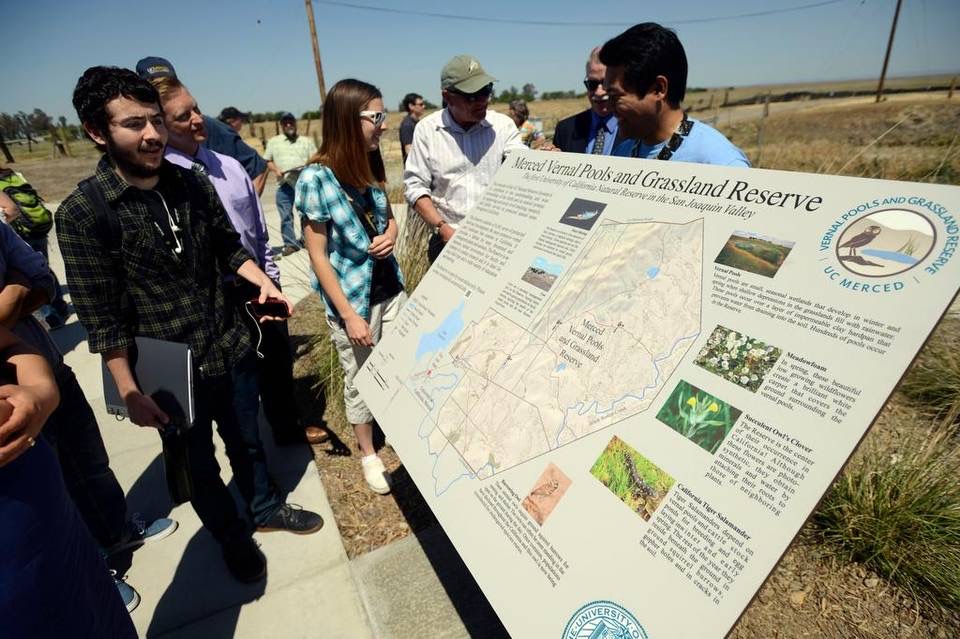
Vernal Pools Reserve - Service Learning Team Members
Scott Walker (Team Leader; Spring 2015; Fall 2014)
Patrick Isaac Coldivar (Deputy Team Leader; Spring 2015)
Stephanie Gimble (Team Leader; Fall 2014; Spring 2014)
Daniel Toews (Team Leader; Spring 2014)
Robert Aguilar (Fall 2014)
Michael Dealbert (Spring 2015)
Andrew John De Los Santos (Spring 2015)
Jake Egger (Spring 2014)
Lauren Garcia (Spring 2014)
Nathan Garcia (Fall 2014)
Logan Graves (Fall 2014)
Amy Hang (Spring 2014)
Jenna Heckel (Spring 2015)
Jose Hernandez-Cruz, Jr. (Spring 2014)
Bryan Juarez (Fall 2014)
Adam Mansour (Spring 2014)
Denzal Martin (Spring 2015)
Robert Martin (Spring 2015)
Maria Martinez (Spring 2014)
William Mayse (Fall 2014)
Maria Medina (Spring 2014; Fall 2014)
Sandy Vasquez Molina (Spring 2015)
Myvi Nguyen (Fall 2014)
Daniel Oh (Spring 2014)
Furkan Ozedirne (Spring 2015)
Adrian Reyes (Spring 2014)
Mark Reynolds (Spring 2014; Fall 2014)
Jessica Rivas (Fall 2014)
Atis Srihiran (Fall 2014)
Brandon Tran (Naturalist leader; Spring 2014; Fall 2014; Spring 2015)
Mai Yee Vang (Fall 2014)
Nick Wlodychak (Spring 2015)
Bao Xiong (Fall 2014)
Lucky Xiong (Spring 2015)

